
Research
Biodiversity is crucial for healthy ecosystems and human well-being. Integrating individual and collective values for biodiversity into plans for using aquatic and riparian habitats is made difficult by a lack of understanding of the processes through which these values are created as well as biodiversity’s position outside traditional market exchange mechanisms. Further complications arise from differences across stakeholders’ preferences, which can complicate decision-making by being poorly understood. The project’s relevance for society lies in its potential to improve individual and collective understanding of values for biodiversity, so that decisions and analysis resting on values for biodiversity’s amenities and services become better able to reflect trade-offs required to provide them through NbS.
Main objectives
ARE BEST NbS will foster stakeholder engagement and promote open communication throughout the process of NbS project implementation to maximize the potential returns from NbS investments that capture diverse biodiversity values and trade-offs. The project addresses four key questions, using collaborative research tools from environmental psychology (mental modelling), economics (stated and revealed preference elicitation), ecology (biodiversity gains) and arts and design (performance, data storytelling) to improve stakeholder engagement, project evaluation strategies and processes, and the impact of artistic collaboration and mental models on the valuation of biodiversity and natural capital.
Key questions
-
Q1
How does stakeholder engagement in NbS project design and implementation affect the values attributed to biodiversity, ecosystem services (ESS) and the natural capital from which they flow? -
Q2
How does collaboration across disciplines affect the values and relation to natural capital and relevant evaluation methods? -
Q3
What are the optimal project evaluation strategies for potential projects that maximize the joint production of biodiversity ESS and management? -
Q4
How can stakeholder engagement and project evaluation be systematically improved so NbS projects create increased credibility, relevance and legitimacy for investments?

Main activities
ARE BEST NbS acts across the local, national, and pan-European scales and three case studies to:
- Evaluate historical records of investments impacting aquatic and riparian habitats for economic and ecological outcomes, using revealed preference techniques and creating synthetic controls for use evaluating NbS;
- Develop and implement national-level experimental surveys combining data-storytelling, and economic theory for eliciting preferences and values for biodiversity (all countries), and local-level narrative survey designs and artistic performance (Danish case study with Vejle membrane NbS) for understanding the impact of lived experiences on stakeholder choices;
- Conduct stakeholder and expert interviews of NbS and use results to map NbS mental models across stakeholder groups to improve engagement (all cases);
- Collect and curate new and existing biodiversity data from NbS investments, using these to develop and test valuation biodiversity frameworks from different stakeholder perspectives (Portuguese case study with riparian forest NbS with water treatment plant);
- Use results to guide recommendations for NbS project evaluation tools and stakeholder engagement, developed and tested with co-design workshops, urban data physicalisation (Hungarian case study with Lake Balaton shore protection NbS) and artistic performances. Project outputs will include artistic performances, academic publications, policy briefs and stakeholder meetings (all cases/ countries).
Impact and Transnational Value
ARE BEST NbS actively involves communities, policymakers, and researchers in Denmark, Portugal, Hungary, Netherlands, and Norway to better understand the many ways people value nature. Through workshops, creative data experiences, and artistic collaborations, stakeholders, from local residents to international decision-makers, can engage with biodiversity benefits and trade-offs in meaningful ways. By comparing case studies across rivers, coasts, and lakes, the project not only highlights local perspectives but also creates a European-wide picture of how NbS support biodiversity and human well-being. This approach strengthens international collaboration, advances methods for valuing nature beyond money alone, and helps policymakers make more inclusive, informed decisions about NbS.
Work packages
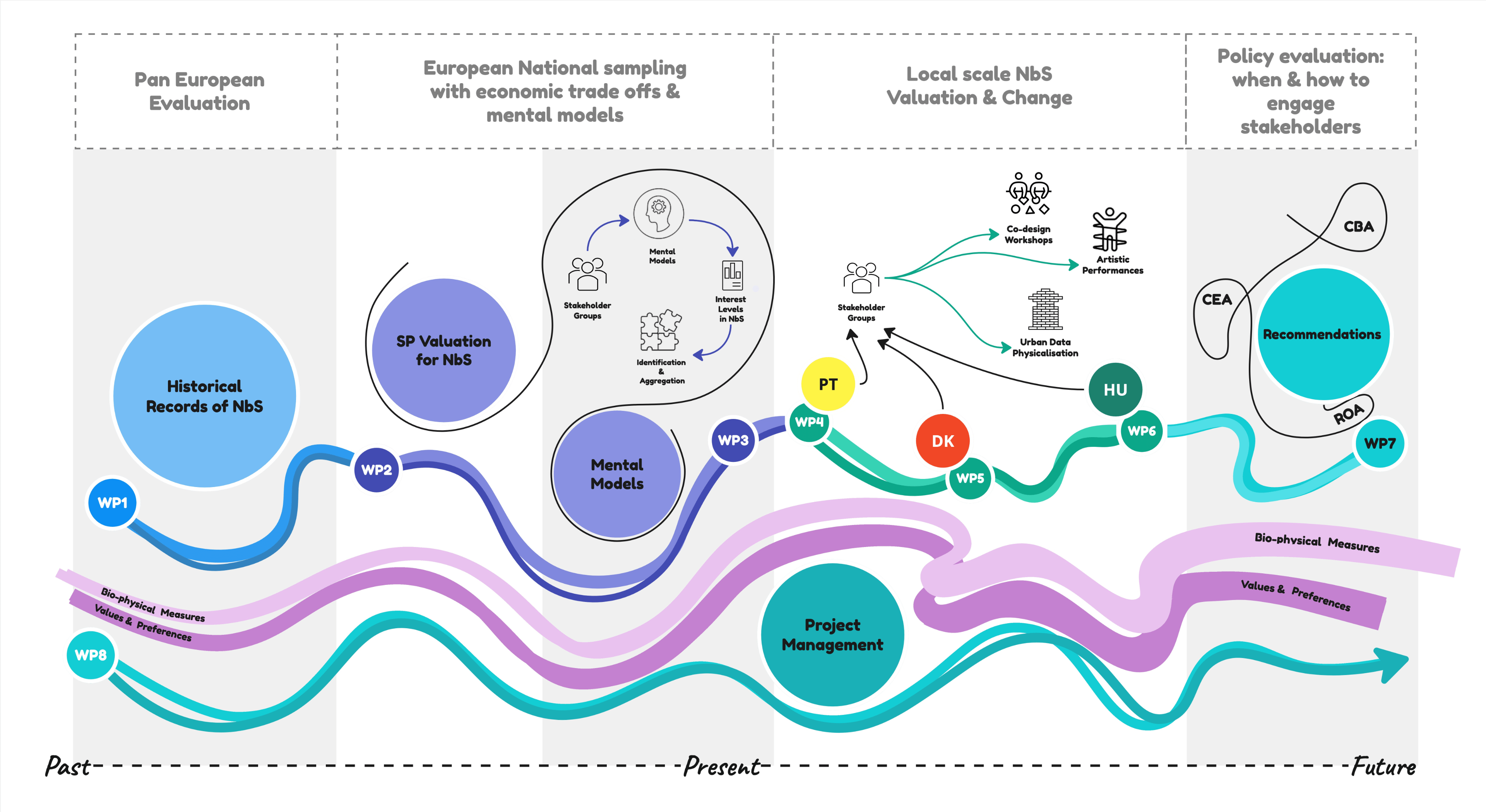
Insights from historical records
Step 1 looks at Europe’s history of rivers, lakes, and wetlands to understand who has benefited from nature over time and how. By comparing past and present landscapes, the project can identify which communities gain from healthy ecosystems and which trade-offs come with changes such as dams or water control structures. This knowledge helps ensure that future nature-based solutions engage the right stakeholders at the right time and balance ecological, social, and economic benefits.
Comparing European Citizen Support for and Valuation of NbS.
Step 2 investigates how do Europeans value NbS. By running large-scale household surveys across several countries, the project explores people’s awareness, attitudes, and preferences, whether for restoring rivers, conserving wetlands, or balancing costs and benefits. These insights help compare values across Europe and give policymakers clearer guidance for designing NbS that reflect what citizens truly care about.
Mental models of NbS and their benefits.
Step 3 explores how different people, as local communities, businesses, policymakers, experts, and the wider public think about the benefits of NbS. By mapping their “mental models”, the project uncovers where perceptions align or differ, and where misunderstandings might stand in the way of collaboration. These insights help build stronger partnerships and more effective NbS that support both biodiversity and human well-being.
Society and company perspectives on NbS: from biophysical evidence to values and preferences.
Step 4 looks at how both communities and companies value NbS in Portugal. By combining ecological data with economic analysis, the project will assess the costs and benefits of restoring river corridors and building wetlands, showing how these NbS improve biodiversity, water quality, and human well-being. Insights from this work will guide better investment decisions and policies that balance environmental responsibility with societal needs.
Understanding Consumer Behavior and Preferences towards Vejle membrane project (Membranen) in Denmark through DCE
Step 5 explores how Danish residents value the Membranen project in Vejle, a major nature-based solution designed to protect the coast from storm surges while enhancing recreation and well-being. By combining national surveys with an artistic performance that invites audiences to reflect on their relationship with water, the project examines people’s preferences, willingness to support NbS, and how creative experiences can shift awareness and behavior. These findings will inform more sustainable coastal planning and citizen engagement in nature-based solutions.
Capturing Stakeholder’s Preferences in Participatory Design Settings: The Hungarian Case
Step 6 focuses on Lake Balaton, Hungary, where a new shoreline protection design encourages natural reedbeds to grow, protecting the waterfront while boosting biodiversity. Through participatory design and data storytelling, local residents, tourists, fishermen, and designers work together to explore the social and ecological benefits of this innovative NbS. The project also brings these insights to the wider public through creative events like local festival, showing how design can connect communities and ecosystems in more sustainable ways.
Recommendations across scales and disciplines
Step 7 brings together insights from all parts of the project to create clear recommendations for policymakers and communities on how to plan and evaluate NbS. Through workshops, creative performances, and tangible data experiences, stakeholders explore different ways of assessing NbS, from cost-benefit analysis to more flexible approaches that capture long-term and hard-to-measure values like biodiversity and well-being. The results will guide a more inclusive decisions that balance ecological benefits, economic trade-offs, and community priorities.